

Suitcase vs. Cargo vs. Courier: The Smart Way to Send to Cuba
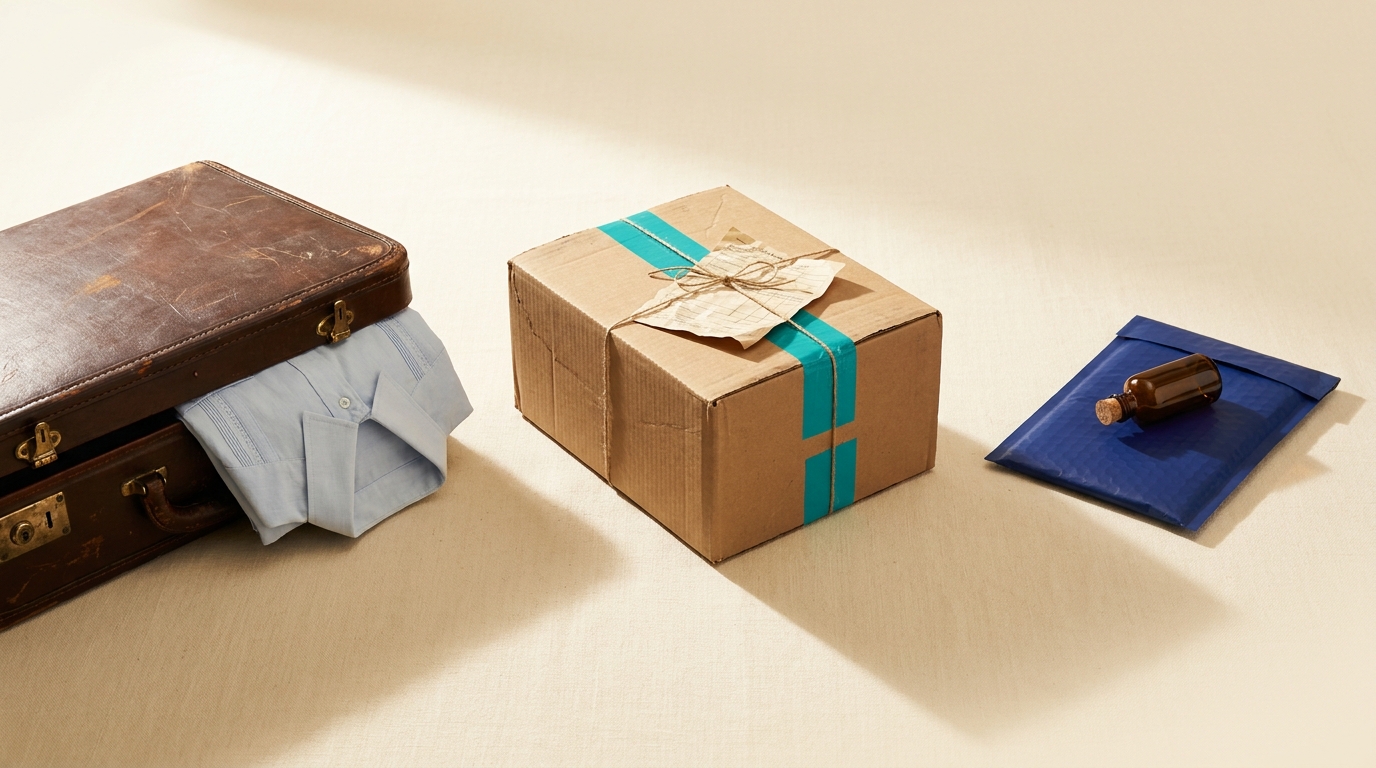
A cousin is traveling to Havana next month. A box of clothes has been sitting in your hallway since June. Your aunt just asked for her blood-pressure medicine. All three of those situations need a different shipping method — and Cuban customs treats each one under its own set of rules. Getting them mixed up is how families end up with seized packages, surprise tariffs, or a suitcase held at the airport.
Here is the plain-language guide we wish every family had before they packed the first box.
The three ways things enter Cuba (and why it matters)
Under current Cuban customs regulations (DL 22/2020 and the resolutions that followed), goods entering the country fall into three legal channels. Each one has its own weight cap, value cap, and duty structure.
- Accompanied baggage — you or a traveler physically carries it on the flight.
- Unaccompanied cargo — a shipment sent as freight, not tied to a passenger.
- Postal / courier (paquetería) — a package sent through a shipping service door-to-door.
Same box of clothes, same box of medicine — the channel you choose changes what's allowed, what it costs, and whether it even makes it through customs.
Option 1: Accompanied baggage (the traveling relative)
This is what a passenger carries when they fly into Cuba. It's the most generous channel by far.
- Up to $1,000 USD in declared value per entry.
- Up to 125 kg total weight per traveler.
- The first 25 kg of personal effects are exempt, plus the first $50.99 USD.
- Progressive duty above the exempt slice: 4% on $51–$500, 8% on $501–$1,000 (first import of the year, permanent residents).
Second and subsequent imports in the same year — or any import by a non-resident — get taxed at 100% and 200% on those same brackets. That's why families usually pack the biggest suitcase for the first trip of the calendar year.
Use accompanied baggage when you have a relative flying in, you can pack under 125 kg, and it's early in the year. The traveler must file the D'Viajeros digital declaration before landing — even for exempt items.
Option 2: Unaccompanied cargo (the freight shipment)
Unaccompanied cargo is exactly what it sounds like: goods travel as freight, no passenger attached. It's the right tool when you're sending something substantial and nobody is flying.
Under the special regime introduced by Res. 139/2025, unaccompanied cargo gets a real break for essentials:
- Exempt up to 50 kg / $500 USD for food, medicine, hygiene products, and medical supplies.
- Items must be in separate, sealed, commercially labeled parcels.
- Anything above those thresholds is taxed at 30%.
General non-essential goods sent as cargo fall under the standard progressive tariff and value-by-weight rules (miscellaneous goods are appraised at $10 USD per kg for duty purposes).
Option 3: Postal / courier shipping (the door-to-door package)
This is the channel most Montreal families use most often, because nobody has to fly. A courier picks up the package here, handles customs on both ends, and delivers to the recipient's home in Cuba.
The trade-off: the courier channel has the strictest limits.
- Maximum $200 USD total value per shipment.
- Maximum 20 kg per shipment.
- Exceed either limit and the package is treated as commercial — meaning seized or returned.
- First 3 kg / $30 USD free even outside the special regime; excess taxed at 30%.
- Food, medicine, hygiene and medical supplies: exempt up to 20 kg / $200 USD under the special regime.
Quick decision guide: which channel fits your situation?
- Sending medicine? Courier is usually the answer, because your family in Cuba can't wait for someone's next flight. Just remember: only certain services (like ours) are legally authorized to ship medicine to Cuba from Montreal — DHL, FedEx, and UPS refuse it.
- Sending a full suitcase of clothes and shoes? If a relative is flying soon, accompanied baggage is cheaper and more generous. If not, split it into two courier boxes to stay under the 20 kg / $200 USD cap each.
- Sending 30+ kg of food or hygiene products? Unaccompanied cargo under the special regime gives you 50 kg / $500 USD exempt — much better than trying to squeeze it through courier.
- Sending a complete solar system? As of Res. 41/2026, photovoltaic kits (panels, inverters, batteries, mounts) are duty-free when presented together as a system — regardless of channel.
Two rules that apply to every channel
No matter which method you pick, these two things never change:
- D'Viajeros declaration is mandatory. Every traveler must file it digitally before arrival, even for items that are fully exempt.
- Duties are calculated in USD, paid in CUP at 1 USD = 24 CUP, plus a fixed 10 CUP clearance fee. The person picking up the shipment pays these at destination — unless (as with our service) customs is already handled and included in your Canadian price.
The channel most Montreal families end up using
Realistically? Most of our customers don't have a relative flying to Havana every month. Their aunt needs her medication now. Their kids just found running shoes on sale at Costco. Their mother's birthday is in ten days.
For those situations, courier shipping is the practical choice — as long as you stay inside the 20 kg / $200 USD cap per package, use the special regime for essentials, and work with a service that legally handles medicine and does the customs paperwork for you. That's the whole point of a fixed CAD price, door-to-door delivery, and a photo confirmation when your family opens the box.
Not sure which channel fits your shipment?
Send us the details on WhatsApp at +1 (438) 873-3589 — what you want to send, roughly how much it weighs, and when you need it there. We'll tell you honestly whether courier makes sense, whether it should be split into two boxes, or whether you should wait for a traveling relative. Real humans, replies typically in under 10 minutes, seven days a week, in Spanish, French, or English. Get a quote here whenever you're ready.